
What is an ultrasonic spray nozzle?
The ultrasonic spray nozzle developed by SinapTec is designed for industrial, scientific and biomedical processes requiring precise and controlled spraying. Thanks to ultrasonic vibrations, it transforms a liquid into fine droplets in order to obtain homogeneous atomization and controlled particle size.
This technology can be used in many applications: coating, thin-film deposition, inhalation, humidification, airborne decontamination, incensing of environments, tracer production, control of confined atmospheres, or spray drying.
How does an ultrasonic spray nozzle work?
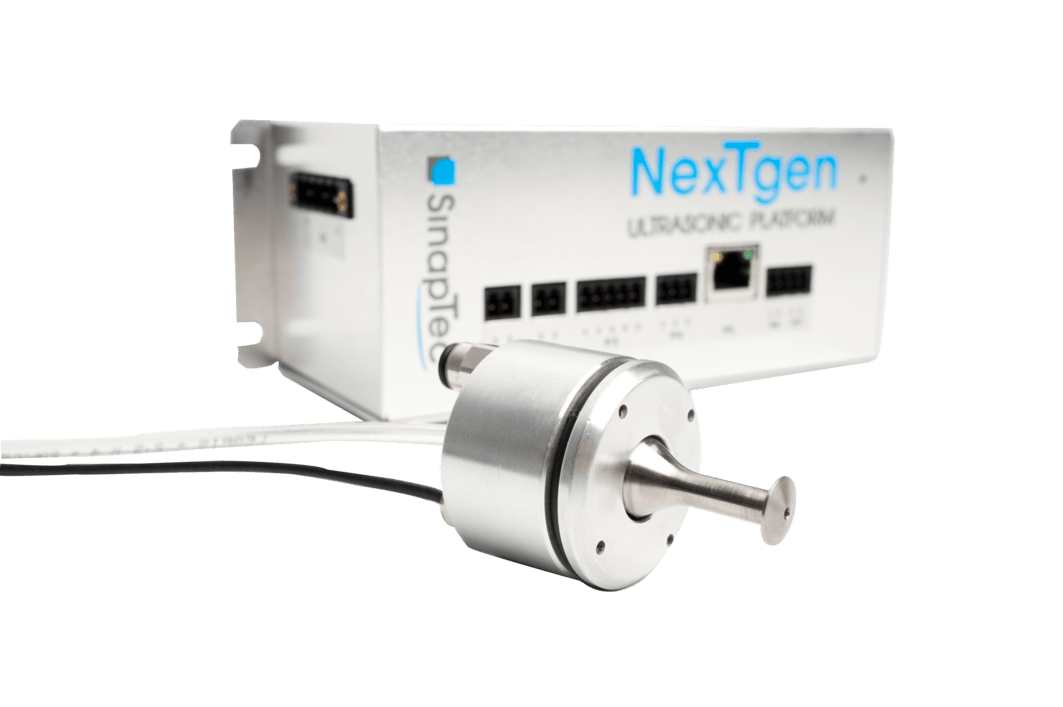
The operation of an ultrasonic spray nozzle is based on the conversion of an electrical signal into high-frequency mechanical vibrations. This role is performed by an ultrasonic transducer, based on a piezoelectric element, which transforms electrical energy into mechanical oscillations.
These vibrations are transmitted to an ultrasonic vibrating surface. When the liquid comes into contact with this surface, it is fragmented into fine droplets. Spraying is therefore obtained without heating the liquid and without using a compressed air flow.
The size of the droplets depends mainly on the ultrasonic frequency used: the higher the frequency, the finer the droplets generated.
Depending on the frequency range, two principles can be distinguished:
🔹 between 20 kHz and 100 kHz, the liquid is sprayed directly in contact with a vibrating surface;
🔹 above 100 kHz, an ultrasonic emitter placed in a volume of liquid generates an acoustic fountain, on the surface of which an aerosol develops.
What parameters influence the quality of ultrasonic spraying?
The performance of an ultrasonic spray nozzle does not depend solely on frequency. Several parameters must be taken into account to define a configuration suited to the ultrasonic spraying process.
The ultrasonic frequency
which directly influences the size of the droplets.
The desired flow rate
depending on the quantity of liquid to be sprayed.
The viscosity of the liquid
which can influence the ease of atomization.
The surface tension
which influences the formation of droplets.
The nature of the formulation
particularly for suspensions, active solutions or sensitive liquids.
The conditions of use
such as the operating environment, temperature or integration into a machine.
The application objective
for example coating, aerosol, humidification, DVA or spray drying.
This analysis is essential to obtain regular spraying, controlled particle size and good process repeatability.
Technical characteristics of our ultrasonic spraying solutions
| Frequency | Power | Particle size | Flow rate |
|---|---|---|---|
| 60 kHz | 30 W | 35 µm | 5 to 80 ml/min |
| 80 kHz | 30 W | 25 µm | 5 to 80 ml/min |
| 2.4 MHz | 20 W | 2.5 µm | 1 to 7 ml/min |
Need help choosing the right frequency?
Contact our experts.
Why choose an ultrasonic spray nozzle for your processes?
01
Controlled particle size for consistent results
The ultrasonic spray nozzle makes it possible to generate fine and homogeneous microdroplets, with a particle size adapted to the requirements of the process.
Control of droplet size and distribution is essential when spraying regularity directly influences the final quality: homogeneous deposition, fine aerosol, regular humidification, particle preparation or controlled diffusion.
02
Cleaner spraying, without compressed air
This ultrasonic spray nozzle generates spraying through ultrasonic vibrations, without the addition of external air. The absence of compressed air helps limit turbulence around the spraying area.
This advantage is particularly important for laboratories, clean rooms, biomedical environments, experimental devices or processes requiring clean and regular spraying.
03
A solution suited to sensitive formulations
Ultrasonic spraying is based neither on high mechanical pressure nor on significant heating of the liquid.
It can therefore be of interest for certain sensitive formulations, particularly in the biomedical, pharmaceutical, fine chemistry, advanced materials or nanoparticle fields.
04
A compact solution for OEM integration
Thanks to its compact format and its design intended for OEM modules, the ultrasonic spray nozzle can be integrated into special machines, industrial equipment or research platforms.
Applications of the Ultrasonic Spray Nozzle
Surface treatment
Coating, surface deposition and thin film
To obtain a regular deposit and control material consumption.
The ultrasonic spray nozzle can be integrated into coating, surface treatment or thin-film deposition processes when deposit regularity and surface quality are decisive.
Biomedical
Inhalation and biomedical aerosols
To transform a liquid formulation into a fine and stable aerosol.
In the biomedical field, ultrasonic spraying can be used to generate aerosols for inhalation, experimental devices, research platforms or biomedical developments.
Controlled atmosphere
Humidification
To maintain stable humidity in sensitive environments.
Ultrasonic spray nozzles can be used to maintain a controlled humidity level in different industrial, agricultural, technical or laboratory environments.
Disinfection
Airborne decontamination, DVA
To diffuse a disinfectant agent in aerosol form in an enclosed space.
In this context, spray quality is essential. A better-controlled ultrasonic nozzle can promote more homogeneous diffusion in the treated space.
Air diffusion
Aromatic or specific solutions
To ensure fine, regular and homogeneous dispersion in the air.
The ultrasonic spray nozzle can be used to diffuse incense, aromatic solutions or specific products into the air, depending on the usage environment.
Tests and measurements
Tracer production
To facilitate the observation, detection or analysis of flows.
This technology can be used to spray liquid tracers in laboratory tests, controlled-environment tests or fluid behavior studies.
Confined environment
Confined atmosphere control
To diffuse a fine aerosol in an enclosure, a clean room or a laboratory.
The ultrasonic atomization system can contribute to regulating humidity, diffusing an active product, generating a test aerosol or maintaining a controlled atmosphere.
Industrial process
Spray drying and powder production
To atomize a solution or suspension before a drying step.
Ultrasonic spraying can be adapted to spray-drying processes when solutions or suspensions need to be transformed into powders or granules.
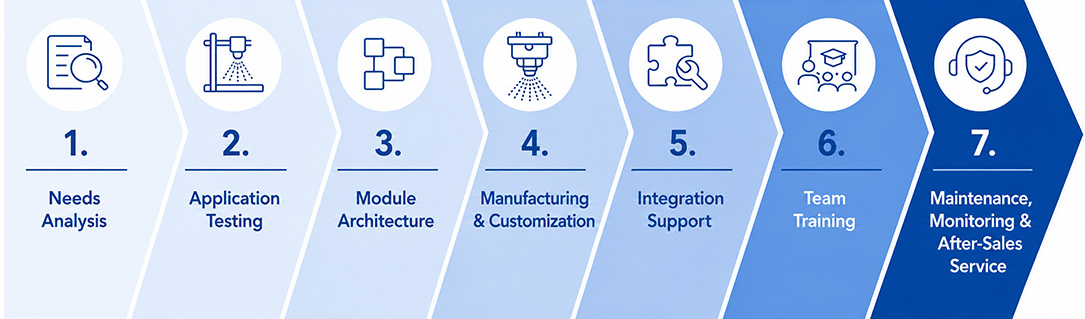
Technical support at every stage of your project
Each ultrasonic spraying project has its own constraints: type of liquid, desired flow rate, droplet size, operating environment or integration into existing equipment.
SinapTec supports you at every stage:
Do you have an ultrasonic spraying project?
Tell us about your application: we help you identify the ultrasonic configuration best suited to your process.
FAQ – Ultrasonic Spray Nozzle
What is the difference between an ultrasonic spray nozzle and a pneumatic nozzle?
A pneumatic nozzle uses compressed air to fragment the liquid, while an ultrasonic spray nozzle relies on ultrasonic vibrations. It therefore does not require any external air supply.
How to choose the frequency of an ultrasonic spray nozzle?
The higher the ultrasonic frequency, the finer the droplets produced. However, the choice of frequency must be adapted to the liquid, the desired flow rate and the constraints of the process.
Which applications are compatible with ultrasonic spraying?
It can be used for coating, thin-film deposition, inhalation, humidification, DVA, tracer production, confined atmosphere control or spray drying.


