
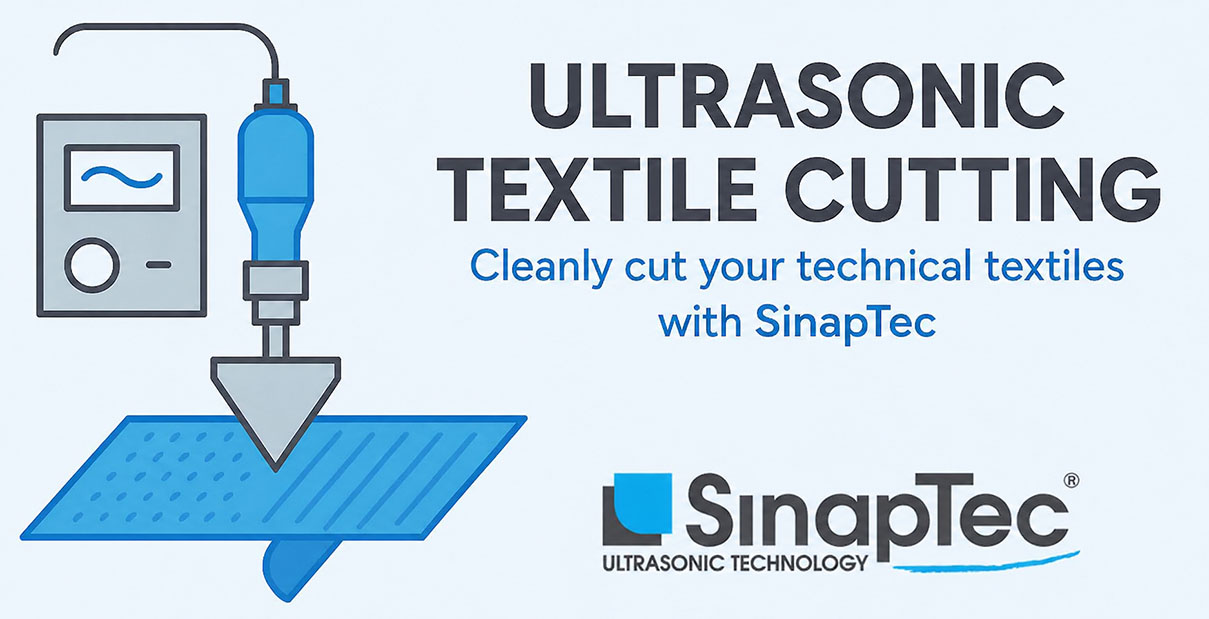
In the world of technical textiles, cutting quality directly impacts the performance, durability, and appearance of your finished products. Frayed edges, material deformation, or composite delamination can compromise an entire process—even when material selection and design are flawless. To meet these challenges, we provide advanced expertise in ultrasonic textile cutting, offering solutions designed to deliver clean cuts while ensuring precise edge control.
By integrating SinapTec ultrasonic modules into your production lines or cutting machines, you combine cutting and sealing in a single operation. This reduces fraying, minimizes finishing steps, and improves overall process cleanliness. Whether you work with nonwovens for hygiene, filtration membranes, geotextiles for construction, or automotive textiles, ultrasonic cutting becomes a powerful lever to enhance your industrial processes.
Our goal is to support you with a textile ultrasonic cutting solution tailored to your materials, production rates, and constraints—leveraging our long-standing experience in industrial and medical ultrasonics.
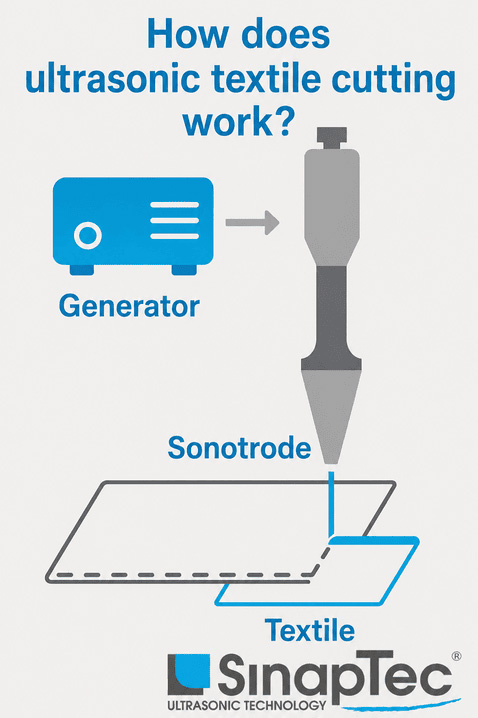
How Does Ultrasonic Textile Cutting Work ?
To fully understand the benefits of ultrasonic textile cutting, it is important to look at its operating principle. At the core of the system, a generator powers a transducer that converts electrical energy into high-frequency mechanical vibrations. These vibrations are transmitted to a tool—the sonotrode—which comes into contact with the textile material.
When the sonotrode touches the material, ultrasonic vibrations generate highly localized heat. For thermoplastic textiles or nonwovens containing thermoplastic fibers, this energy causes controlled melting at the cutting zone. The ultrasonic blade does more than just cut—it simultaneously seals the edges. This allows you to achieve clean cuts with sealed edges, without using adhesives, threads, or heat-sealing tapes.
This controlled fusion is at the heart of ultrasonic cutting value, as it:
- Significantly reduces fraying
- Prevents fiber unraveling
- Improves edge mechanical strength
Compared to conventional mechanical cutting, it also reduces fiber pulling, material deformation, and delamination risks in multilayer textiles.
The heat-affected zone remains extremely limited. This is critical for technical membranes or composites sensitive to temperature variations. Unlike heated blades that may damage surfaces or alter functional properties, ultrasonic energy is concentrated precisely at the cutting edge—preserving the original material properties.
Specific Challenges of Technical Textiles and Nonwovens
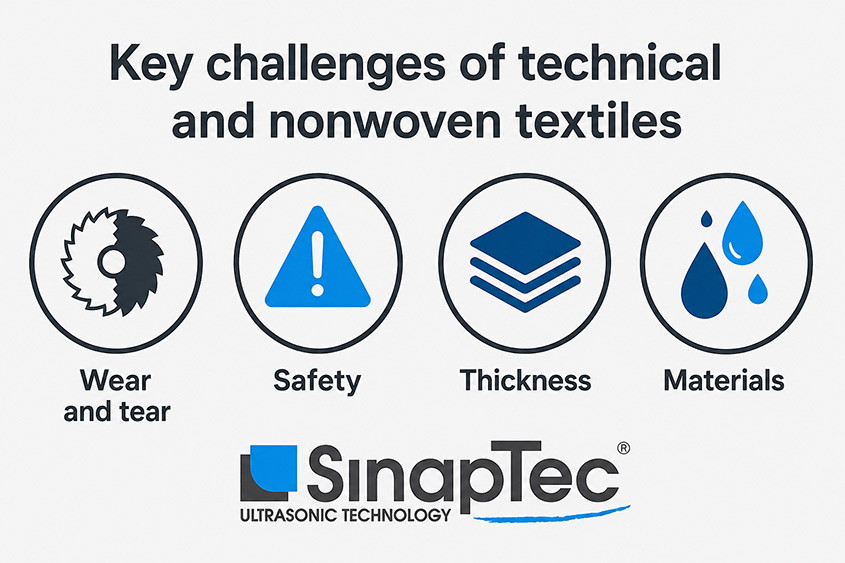
Technical textiles are not simple materials—they perform essential functions such as protection, filtration, reinforcement, insulation, hygiene, and safety.
Their structure is often complex, involving synthetic fibers, multi-material blends, dense weaves, nonwoven structures, layered assemblies.
This complexity creates challenges during cutting. Conventional cutting methods can lead to irregular edges, fiber pull-out, local deformation, and airborne fibers—especially in nonwovens. Geotextiles may lose edge strength, nonwovens may degrade during handling, and composites may delaminate. For applications exposed to mechanical stress, harsh environments, or strict hygiene standards, such defects are unacceptable.
In nonwoven materials, fibers are bonded together through mechanical, chemical, or thermal bonding. An inappropriate cutting method can disrupt this balance and create a weakened edge zone. In contrast, ultrasonic cutting of technical nonwovens helps stabilize the material structure at the cutting edge by welding the fibers together. The result is a compact, uniform edge with improved resistance to mechanical stress.
For multilayer textiles, edge control is just as critical. Composite materials used in filtration, automotive, or personal protective equipment (PPE) must maintain their structural integrity. If layers begin to separate, overall performance can quickly degrade. Ultrasonic textile cutting enables precise cutting of these sensitive materials while simultaneously consolidating the edge, reducing the risk of delamination or layer separation.
In short, the more advanced your textile structure, the more critical your cutting technology becomes—and this is where ultrasonic textile cutting solutions deliver real value.
Concrete Benefits for Your Production
Ultrasonic textile cutting does more than just improve the visual quality of edges. It fundamentally transforms your production organization and cost control. When we integrate an ultrasonic cutting module into your process, we always aim to measure these tangible impacts.
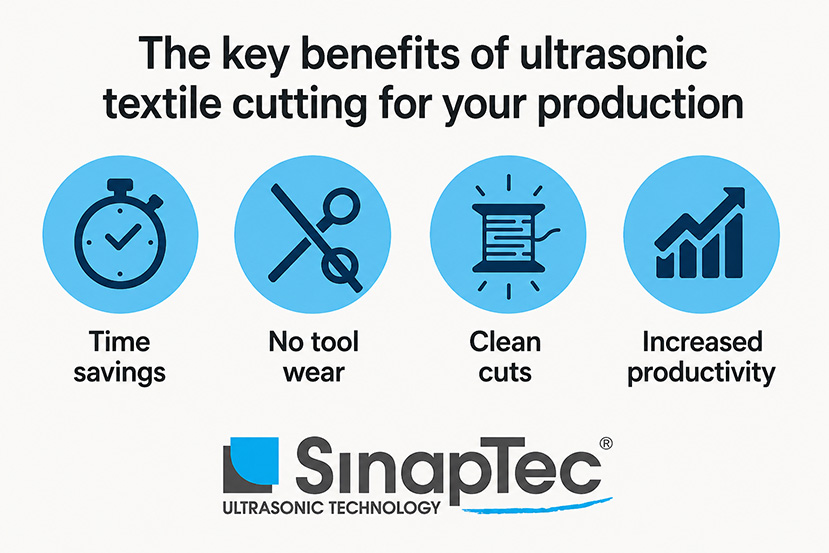
- The first benefit lies in the finishing stages. With traditional processes, additional operations are often required to manage edges: trimming, sewing, heat sealing, or adding tapes and reinforcements. By sealing the edges during cutting, ultrasonic textile cutting eliminates part of these steps. Your parts come out of the machine with clean, stabilized edges, ready for the next stages of your production line.
- The second benefit concerns the reduction of defects and scrap. Frayed edges, material deformation, or composite layer separation can lead to rejected parts. By using ultrasonic cutting for technical textiles, you address these issues at the source. Quality becomes more consistent from one batch to another, and rework or rejection rates decrease. This is particularly critical for medical nonwovens, filtration media, or geotextiles produced in large lengths.
- The third benefit relates to workshop cleanliness and product safety. Loose fibers and dust generated by mechanical cutting are often difficult to control. In healthcare, pharmaceutical, or hygiene sectors, this material dispersion can be problematic. Ultrasonic cutting of nonwovens significantly reduces this issue, as the material is sealed at the edge at the exact moment it is cut. This helps reduce particle levels in the working environment.
- Finally, ultrasonic textile cutting contributes to the rationalization of your consumables. By eliminating adhesives, threads, and certain heat-sealing operations, you simplify your production logistics. You have fewer materials to manage, fewer consumables to store, and fewer interruptions related to their replacement.
Applications of Ultrasonic Textile Cutting by Industry
The versatility of ultrasonic textile cutting allows it to be used across a wide range of industries, each with its own specific constraints. We adapt our solutions to these requirements by optimizing key parameters such as frequency, power, pressure, and tool geometry.
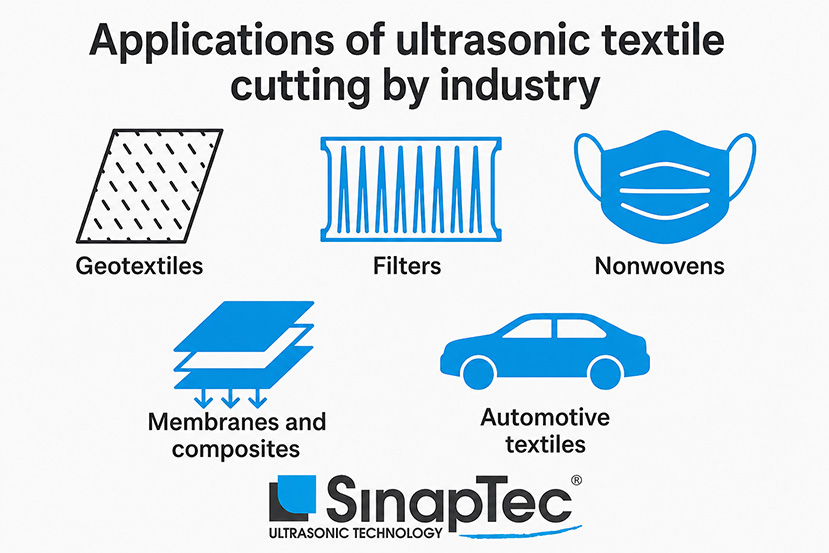 Geotextiles for construction, civil engineering, and environmental applications
Geotextiles are widely used in projects involving soil reinforcement, water filtration, slope stabilization, and underground membrane protection. An edge that frays, tears, or folds during installation can compromise the material’s performance and continuity. With ultrasonic textile cutting, geotextile strips and components are produced with sealed edges directly during the cutting process. During on-site installation, the material remains stable, even under significant mechanical stress. As a result, you improve long-term durability, reduce material waste, and minimize the need for rework or repairs on the finished product.
Industrial filters in nonwovens and technical textiles
Industrial filters—whether designed for air, liquids, or gases—require precise geometries and well-controlled edges. An inaccurate cut can disrupt filter assembly, create leakage zones, or weaken the overall structure. With ultrasonic cutting of textile filters, complex shapes can be produced while maintaining sealed edges. The structure of the nonwoven or technical textile remains intact, fibers do not detach during assembly, and the component retains its shape. For high-value filtration applications, edge quality becomes a key factor in ensuring product reliability and long-term performance.
Nonwovens for hygiene and medical applications
Nonwoven materials used in hygiene and medical applications are at the core of products such as masks, wipes, protective garments, surgical drapes, and medical device components. These materials must meet strict requirements in terms of comfort, safety, cleanliness, and regulatory compliance. By using ultrasonic textile cutting for medical nonwovens, manufacturers can cut mask contours, complex hygiene product shapes, or protective components while simultaneously sealing the edges. This approach helps to reduce skin irritation risks, limit loose fibers at the edges, and facilitate integration into high-speed automated production lines.
Membranes and multilayer composite textiles
Technical membranes and multilayer composite textiles are often selected for specific properties such as filtration, breathability, chemical resistance, and insulation. Poor cutting quality can disrupt this balance by creating defects or damaging the interfaces between layers. With ultrasonic cutting of membranes and composite textiles, these materials can be processed while consolidating the edge zone, ensuring that fusion remains localized, the overall structure is preserved, and the risk of delamination is reduced. This allows manufacturers to achieve more complex geometries, precise contours, and more reliable assemblies.
Automotive textiles and personal protective equipment
Textiles used in automotive interiors, seating, panels, and comfort components must deliver impeccable edge quality, as they directly impact perceived product quality. At the same time, personal protective equipment (PPE) must meet strict requirements in terms of safety, durability, and user comfort. By integrating ultrasonic textile cutting for automotive and PPE applications, manufacturers obtain components with clean, reinforced, and visually controlled edges, enabling simplified assembly, reduced rework, and improved durability. For your customers—whether OEMs, suppliers, or end users—this translates into a higher-quality and more reliable long-term experience.
Ultrasonic Textile Cutting Technology Designed for Integration
SinapTec ultrasonic textile cutting solutions are designed to integrate seamlessly into your existing equipment or new machines. We provide OEM modules combining ultrasonic generators, transducers, and sonotrodes tailored to your industrial requirements.
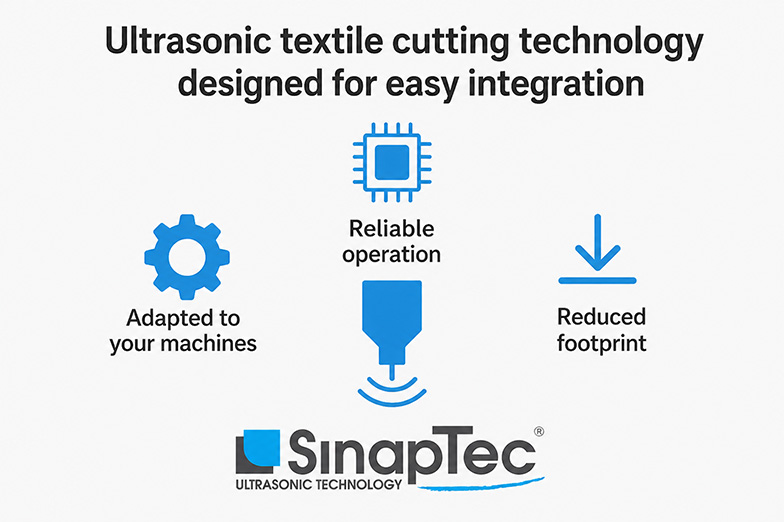
The ultrasonic generator controls frequency, power, and operating parameters. It ensures stable vibration, monitors operating conditions, and adaptes to load variations. This level of control is essential to ensure consistent and repeatable ultrasonic textile cutting performance over time.
The transducer converts electrical energy from the generator into ultrasonic vibrations. Combined with a sonotrode designed for your specific ultrasonic application, it forms the core of the system. Tool geometry is defined accroding to your materials, thickness, cutting shape, and production speed to achieve both clean cuts and sealed edges.
The entire system is designed to interface with your automation environment. You can control ultrasonic textile cutting through your existing interfaces, adjust parameters, monitor system performance, and integrate diagnostic functions. This makes operation easier for both production and maintenance teams.
Adapting Ultrasonic Textile Cutting to Your Industrial Constraints
Every ultrasonic cutting project for technical textiles begins with a detailed analysis phase. Understanding your materials, requirements, and production constraints allows us to define the most suitable technical configuration.
We analyze the type of technical textiles you process, whether lightweight nonwovens, thick geotextiles, thin membranes, or multilayer composites. Based on this, we recommend optimized frequency, power, and pressure parameters tailored to your application. The objective is to achieve the right balance between cutting speed, edge quality, and tool durability.
Production speed plays a critical role. A high-speed medical mask production line, with rapid cycles and high throughput, requires a completely different approach compared to geotextile panel cutting operations. SinapTec ultrasonic modules are designed to adapt to highly diverse production profiles, ensuring both stability and repeatability.
We also take your maintenance requirements into account. Ultrasonic textile cutting must operate reliably in industrial environments where unplanned downtime directly impacts productivity. That is why we place strong emphasis on component robustness, assembly quality, and advanced diagnostic capabilities.
By taking this approach, ultrasonic textile cutting becomes a reliable and controlled part of your overall process, rather than an additional source of complexity in already demanding industrial environments.
Comprehensive Support from Testing to Production Ramp-Up
When considering the integration of ultrasonic textile cutting, you need clear validation of material behavior, achievable quality, and industrial feasibility. We support you at every stage to help secure your decisions.
- The first step typically involves testing your own technical textiles under conditions close to your industrial environment. We assess edge quality, the presence of fraying, mechanical strength, handling behavior, and the impact on process cleanliness. These tests allow us to fine-tune parameters and confirm the relevance of ultrasonic technology for your products.
- We then focus on practical integration into your machines or production lines. We collaborate with your teams, equipment manufacturers, and system integrators to define the positioning of SinapTec ultrasonic modules, the control interface, and communication with your automation systems. The objective is to ensure smooth implementation and avoid unexpected issues during start-up.
- Finally, once the solution is installed, we remain available to support production ramp-up, parameter optimization, and team training. Ultrasonic textile cutting becomes a fully integrated capability within your organization, supported by our expertise and experience in industrial ultrasonic technologies.


