
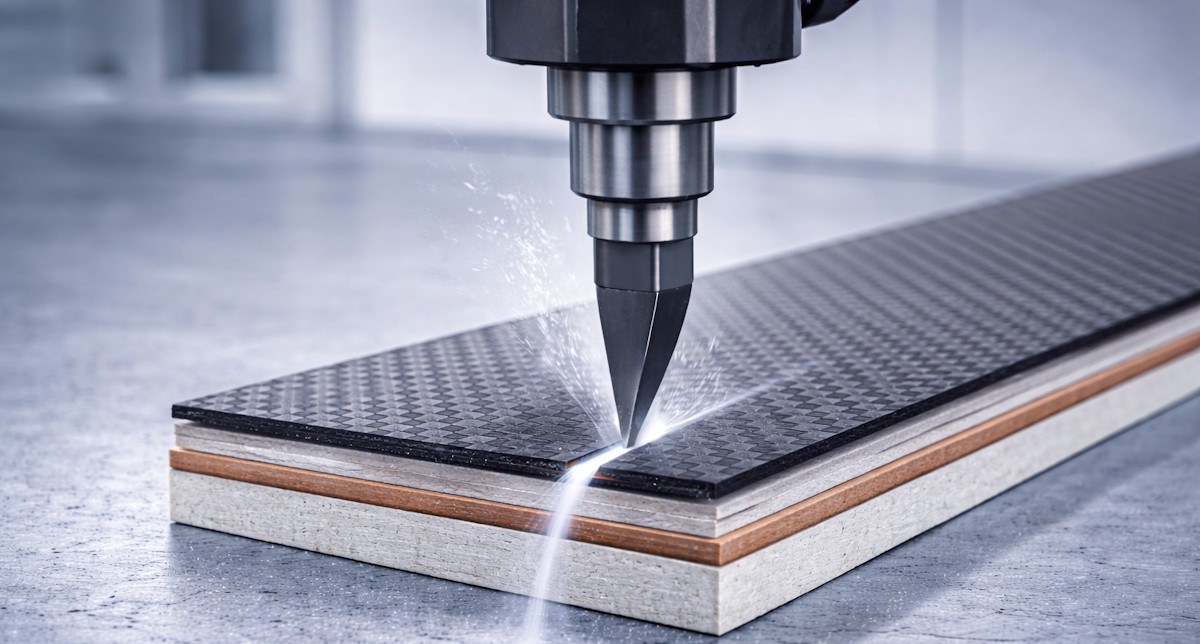
Technical and composite materials now play a central role in industry. They make it possible to lighten structures, increase mechanical resistance, improve thermal or acoustic performance, and combine several functions within a single part. But this sophistication has a direct impact on your processes: cutting becomes more delicate, more sensitive, and edge quality often determines the overall quality of the finished product.
This is precisely where ultrasonic cutting comes into its own. As experts in ultrasound-based technologies, we provide ultrasonic cutting solutions designed to preserve the internal structure of materials, reduce mechanical stress during cutting, and control heat build-up or delamination phenomena. Whether you work with thin films, foams, flexible rubbers, thermoplastic multilayers, or complex laminates, ultrasonic cutting of composite materials becomes a real performance driver for your production lines.
Here, we invite you to explore in detail the specific challenges of these materials, the principles of ultrasonic cutting, the concrete benefits for your workshop, and how we can integrate this technology at the heart of your machines.
What characterizes technical and composite materials
Before discussing tools or processes, it is essential to look at the very nature of the materials you process. Composite materials are not simple homogeneous sheets. They are designed to meet demanding requirements and often combine several properties within a single structure.
- A technical material may be a very thin plastic film intended for high-barrier packaging, polyurethane foam for furniture, polyethylene foam for protection, flexible rubber for sealing or damping, or a specific membrane for electronics or medical applications. These materials can be fragile, heat-sensitive, or vulnerable to mechanical stress, and they do not always withstand the aggressive effects of conventional cutting.
- A composite or thermoplastic multilayer material combines several layers: barrier films, protective layers, adhesives, fabrics, reinforcements, foams, and membranes. Each layer has its own role, chemical nature, and response to stress and temperature. The challenge is to ensure that the entire structure behaves as one coherent material. As soon as one layer detaches or deforms, the overall balance is compromised.
When a cutting technology is applied to these materials, the way energy is delivered — through mechanical pressure, friction, or heat — has a direct impact on the stability of the interfaces. This is where ultrasonic cutting of composite materials stands apart from traditional mechanical or thermal cutting.
Why ultrasonic cutting changes the game
In conventional mechanical cutting, material separation takes place through shearing. The tool applies significant pressure to the material, sometimes combined with tensile stress. On a homogeneous material, this approach may remain acceptable. On a composite or multilayer material, however, these forces can cause separation between layers, local deformation, or excessive heating at the edge.
With ultrasonic cutting, the principle is different. A generator powers a transducer, which makes a sonotrode vibrate at an ultrasonic frequency. This vibration is transmitted to the cutting tool as it comes into contact with the material.
The energy is no longer purely mechanical: it becomes vibrational.
At the microscopic level, the vibration creates a highly localized friction zone. The material heats up at the contact point, without the entire thickness of the material undergoing a rise in temperature. In the case of thermoplastic materials, or materials containing thermoplastic components, this energy is enough to soften the material precisely where the cut is made. The tool can then pass through the material with much less force, significantly reducing the stress applied to the underlying layers.
It is this combination of vibration, controlled heat, and reduced pressure that gives ultrasonic cutting its strength. It makes it possible to cut fragile, elastic, thick, or multilayer materials while limiting the risks of crushing, deformation, or delamination. Whenever you need a clean and repeatable cut on sensitive materials, ultrasonic cutting of composites becomes a benchmark solution.
The advantages of ultrasonic cutting
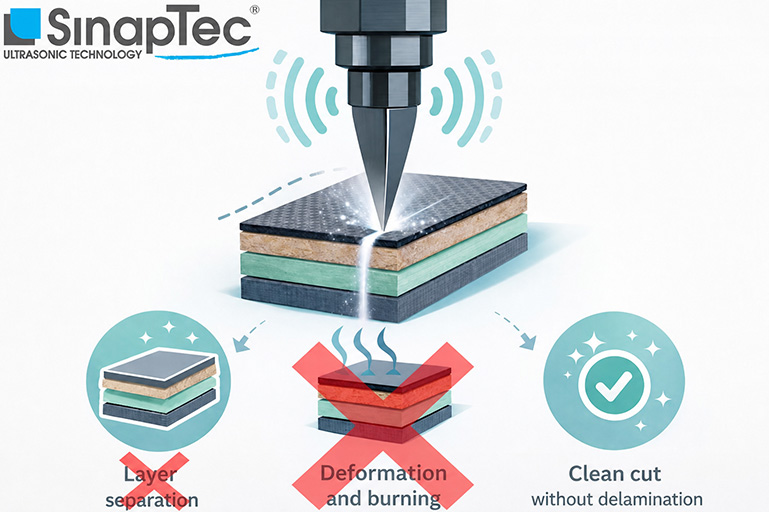
When we study an ultrasonic cutting project with an industrial manufacturer, we look at both the material itself and the final use of the part.
For multilayer materials: multiple benefits
For multilayer or composite materials, several benefits come up consistently.
- The first benefit is the protection of the internal structure. Ultrasonic cutting of composites limits tensile stress at the interfaces. The layers remain bonded, even in the immediate area around the cut. This reduces the risk of delamination, internal microcracks, or layer separation that could later result in a defect during use.
- The second benefit is related to edge quality. With traditional cutting, edges can be rough, slightly melted, or collapsed. In a thin film, this can cause assembly or bonding issues. In foam, it can affect appearance and dimensional accuracy. With ultrasonic cutting, the edge is clean and precise, with limited burrs. The repeatability of this quality throughout production runs is a major advantage for high-value-added manufacturing.
- The third benefit concerns heat control. Sensitive composites cannot withstand excessive heating, which may alter the resin, deform reinforcements, or damage surface films. Ultrasonic cutting concentrates heat in a very narrow area, directly along the cutting line. The material thickness as a whole remains close to its initial temperature, helping preserve its functional properties.
- Finally, a fourth benefit appears in terms of productivity. Reduced cutting forces, almost no material adhesion to the ultrasonic blade, and long-term process stability allow high production rates and fewer stoppages for cleaning or adjustments. Ultrasonic cutting is not only a quality-focused technology; it is also a tool for optimizing your production efficiency.
For thin plastic films: essential precision
Thin plastic films used in packaging, electronics, or surface protection are typical technical materials that create cutting challenges. Their low thickness, heat sensitivity, and possible varnishes or surface treatments make mechanical cutting delicate.
With conventional cutting, edges may soften, slightly stick together, or show burrs that are difficult to control. For films intended for bagging, thermoforming, or laminating operations, these defects can lead to jams, blockages, or sealing defects.
By adopting ultrasonic cutting for these films, you obtain a clean cut, with edges that remain well separated and do not fuse together in an uncontrolled way. The vibration reduces cutting force and limits the heat-affected zone. The geometry of the parts remains precise, which facilitates later assembly or integration operations.
Our ultrasonic cutting modules can be integrated into continuous cutting lines, packaging forming machines, or dedicated film preparation stations for electronics. We adjust frequency and power according to the thickness, polymer type, and target production rate to ensure stable operation over time.
For PU and PE technical foams: fine cutting without crushing
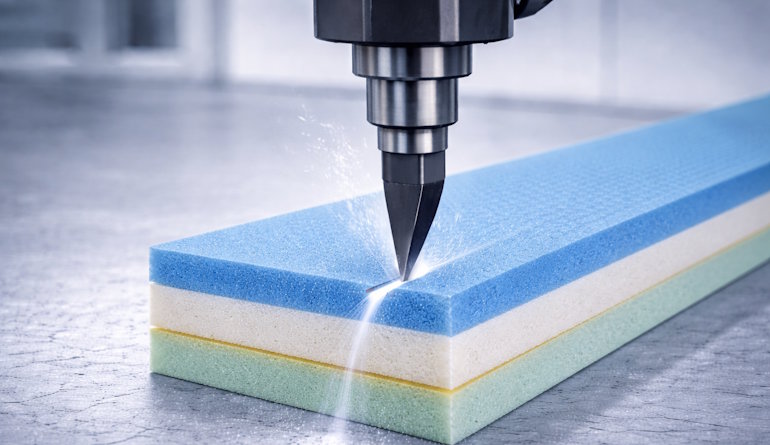
Polyurethane and polyethylene foams are widely used in insulation, furniture, protective packaging, and the automotive industry. Their cellular structure, which gives them their value, also makes them sensitive to conventional cutting methods. A mechanical blade tends to compress the foam before cutting it, causing deformation, unpredictable elastic recovery, and irregular edges.
Ultrasonic cutting provides a suitable solution here. Tool vibration allows the blade to pass through the foam with reduced pressure. The material is less compressed, the cells are better preserved, and the edges remain closer to the nominal geometry. For insulation parts or assembly elements, this means better dimensional accuracy and more reliable fitting.
In comfort applications or shock-absorbing components, the clean cut achieved with ultrasonic cutting directly contributes to the perceived quality of the finished product. The edges are clean, with no torn fibers or ripped areas. For foams combined with other layers, such as films or fabrics, ultrasonic cutting of composites makes it possible to process the full structure in a single operation, without separating the different layers.
For flexible rubbers: smooth cutting and complex shapes
Flexible rubbers are used in seals, damping elements, anti-vibration parts, and functional components across many sectors. Their elasticity makes them difficult to cut cleanly with traditional tools. The blade can pull the material, generate burrs, or leave residues that compromise sealing performance.
Ultrasonic cutting offers an interesting alternative. By combining vibration with reduced cutting force, it makes it possible to obtain smooth contours, even for complex shapes. The edges do not show torn fibers or rough surfaces. For your seals, this means better sealing performance and longer service life, as stress concentration areas are limited. For parts combining rubber with other materials, our ultrasonic cutting approach for composites ensures a clean separation across the full thickness, without tearing at the interface.
For thermoplastic multilayers and laminates: controlling delamination
Thermoplastic multilayers and laminates are among the materials most sensitive to cutting quality. They combine barrier films, protective layers, adhesives, reinforcements, or decorative elements. Poorly controlled cutting can cause separation, blisters, internal cracks, or loss of mechanical performance.
With ultrasonic cutting of composite materials, we aim to preserve interface integrity as much as possible. Vibration reduces shear stress between layers, while heat remains concentrated in a very fine area. In some cases, the slight fusion obtained at the edge can even help bond the layers more firmly near the cut.
For laminates used in packaging, electronics, medical applications, or aerospace, this control of the cutting process is decisive. It ensures a clean finish, stable dimensions, and consistent performance from one production run to the next. Where conventional cutting may create starting points for delamination, ultrasonic cutting becomes a way to make the process more reliable.
Integrating an ultrasonic cutting solution for composites into your production lines
A technology only creates value when it can be efficiently integrated into your industrial environment. That is why we work with OEM modules combining generators, transducers, and sonotrodes, designed for ultrasonic cutting of technical and composite materials.
We start by analyzing your materials, thicknesses, production rates, and quality objectives with you. This step allows us to define the parameters of the ultrasonic cutting process: frequency, power, tool shape, support conditions, and cutting speed. Tests carried out on your own parts are then used to validate these choices and observe the edge behavior, interface integrity, and process stability in real conditions.
Once the configuration has been established, we work with your teams or your integrators to implement the solution on your machines. Ultrasonic cutting modules for composites are designed to communicate with your automation systems, integrate into your safety systems, and meet your cleaning constraints, particularly in sectors subject to strict requirements.
Our approach does not stop at start-up. We support you during ramp-up, setting optimization, and team training. The goal is for ultrasonic cutting to become a fully mastered capability within your workshop, able to adapt to new materials or new geometries as your projects evolve.
Turning ultrasonic cutting into an asset for your technical materials
Technical and composite materials represent a significant investment in development and production. They deliver major performance gains, but they also require a high level of control across the entire processing chain. By choosing ultrasonic cutting, you align your cutting process with these requirements, using a technology that preserves the internal structure of your materials, secures edge quality, and supports the productivity of your production lines.
Together, we can turn ultrasonic cutting of your composites into a true differentiator for your products, making full use of the potential of your films, foams, rubbers, thermoplastic multilayers, and laminates, while keeping your production costs and final quality under control.


