
As technological and biomedical advances continue to evolve, ultrasound has consistently demonstrated its ability to interact with the human body in a precise and non-invasive way. Among these promising innovations, LIFU—Low-Intensity Focused Ultrasound—stands out as part of a new generation of therapeutic tools. Rather than aiming to destroy tissue, this technology is designed to modulate, stimulate, or support the body’s natural biological processes.
Thanks to this gentle approach, it becomes possible to target deep tissues without incision, without significant heating, and yet with measurable effects on cellular or neural activity. As a high-precision ultrasound solution, LIFU paves the way for a more refined, personalized, and biologically respectful form of medicine.
In this article, we offer a detailed exploration of this modern technology—from its underlying mechanisms to its latest application areas—along with an introduction to the solutions we develop at SinapTec to meet your clinical and scientific needs.
What is Low-Intensity Focused Ultrasound (LIFU)?
LIFU technology, an acronym for Low-Intensity Focused Ultrasound, is based on the use of low-intensity focused ultrasound waves. Unlike high-intensity ultrasound (HIFU), which is used to generate destructive thermal effects, LIFU relies on lower energy levels designed to interact with tissues in a non-damaging way.
The objective is not to harm or heat biological structures, but to induce functional changes—either reversible or long-lasting—depending on the parameters applied.
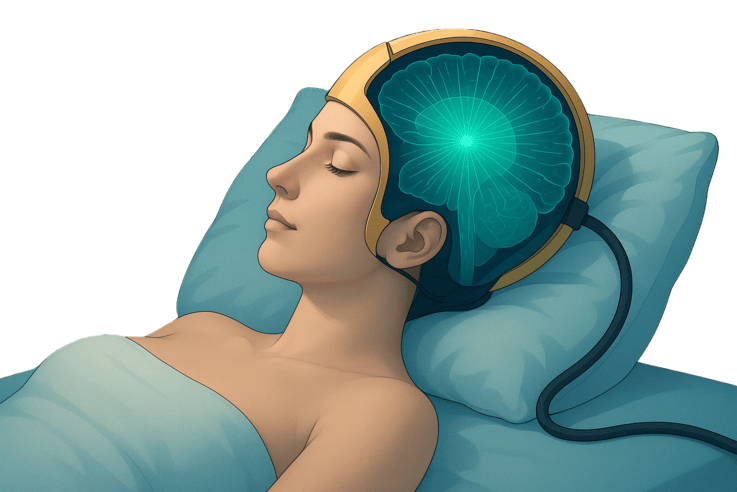
These ultrasound waves, focused at a precise point within the body, can generate subtle mechanical effects, such as cellular membrane displacement, changes in permeability, or temporary modifications of the cellular environment. Although the acoustic intensity is low, it is sufficient to influence cellular or neuronal activity without causing tissue destruction. This specific positioning gives LIFU a strong potential in neuromodulation applications and in stimulating regenerative biological processes.
The approach is fully non-invasive, requiring no incisions or insertion of probes into the body. It relies on systems that emit ultrasound from outside the body, typically combined with medical imaging technologies to ensure precise targeting and real-time monitoring. This integration between ultrasound delivery and imaging is a key factor in ensuring both the safety and effectiveness of the method.
How LIFU Works
The principle of LIFU technology is based on the convergence of low-intensity acoustic waves toward a precise area within the body. This focusing allows ultrasonic energy to be concentrated without generating heat or cavitation, unlike high-intensity protocols. This key characteristic enables the method to be applied to highly sensitive targets, such as brain tissue, without altering their structure.
The biological effects of LIFU can be grouped into several mechanisms. The first is a mild mechanical effect, which can induce transient deformation of cellular membranes, modifying their permeability and facilitating the transport of molecules. The second mechanism involves biochemical stimulation: repeated exposure to low-intensity waves can trigger beneficial cellular responses, such as the production of growth factors, the migration of stem cells, or the modulation of inflammatory responses.
In the field of neurology, these effects translate into the modulation of neuronal activity. It becomes possible to increase or decrease the excitability of a targeted brain region without damaging neurons or altering their immediate environment. This capability opens up significant opportunities in non-invasive neuromodulation, offering an alternative to electrical stimulation or invasive surgical procedures.
The effectiveness of LIFU also relies on real-time guidance. The use of MRI or ultrasound imaging allows precise verification of the focal point positioning, adjustment of emission parameters according to depth, and continuous monitoring of tissue responses. This constant visual feedback is essential to ensure compliance with safety thresholds and to optimize the therapeutic impact of each session.
LIFU Applications
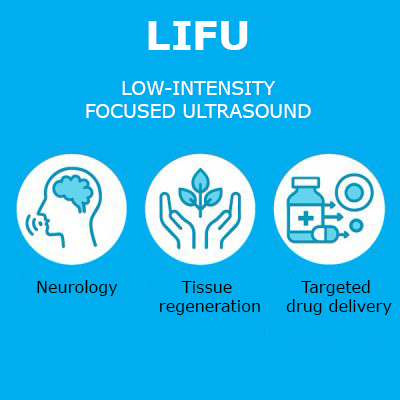
One of the key strengths of Low-Intensity Focused Ultrasound (LIFU) lies in its versatility. Thanks to its ability to interact with tissues in a non-destructive way, this technology has expanded across multiple medical fields—from neurology to regenerative medicine, as well as applied biomedical research. Its applications are numerous and often complementary to existing approaches.
🔹 Neurology
In neurology, LIFU is primarily used for neuromodulation—that is, the selective activation or inhibition of specific brain regions involved in various disorders. It is particularly relevant in the management of conditions such as essential tremor, certain forms of treatment-resistant depression, and epilepsy. Unlike more invasive methods, this modulation is achieved without surgery, and its effects are both reversible and adjustable.
Another emerging application in this field is the transient and controlled opening of the blood-brain barrier (BBB). By combining low-intensity focused ultrasound with microbubbles, it is possible to create temporary openings in this physiological barrier, allowing therapeutic agents to pass through. This approach is opening new perspectives for the treatment of brain tumors and neurodegenerative diseases.
🔹 Tissue Regeneration
The field of tissue regeneration also benefits significantly from LIFU technology. By stimulating cellular activity, it can accelerate healing processes, promote muscle recovery after injury, and support bone regeneration. These effects are achieved without thermal stress, making the technology suitable for repeated use, particularly in rehabilitation and sports medicine.
🔹 Targeted Drug Delivery
In targeted drug delivery, LIFU enhances the uptake of therapeutic molecules across cellular membranes. This technique, known as sonoporation, is especially valuable in biomedical research, as it improves treatment efficiency while reducing the required dosage. It is also being explored for the localized delivery of viral vectors, nanoparticles, or therapeutic agents directly into specific tissues.
🔹 Laboratory and Research Applications
In laboratory settings, LIFU is widely used as an experimental tool to study the mechanical effects of acoustic waves on cells. It enables researchers to investigate cellular signaling, membrane permeability, and tissue sensitivity to mechanical stimuli. Its non-destructive nature makes it particularly suitable for both fundamental research and the development of new therapeutic approaches.
LIFU Amplifier Solutions Developed by SinapTec
To support clinicians, researchers, and industrial partners in implementing LIFU technology, we develop ultrasound systems tailored to the precision and complexity of this approach.
Our goal is to provide modular platforms capable of generating low-intensity focused ultrasound with maximum accuracy, while offering a high level of control over all emission parameters.
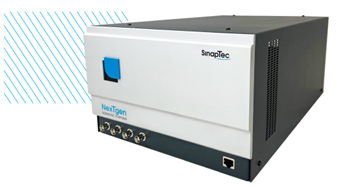
Our systems are built on a flexible architecture, designed to adapt to a wide range of protocols. Whether you are targeting deep brain structures, regenerating muscle tissue, or working within a preclinical model, our platforms enable precise control over intensity, frequency, pulse duration, and waveform shape. This level of technical control ensures treatment reproducibility while maintaining strict compliance with safety thresholds.
We have designed our platforms to be compatible with medical imaging technologies, particularly MRI and ultrasound. The integration of these tools enables highly accurate targeting of treatment areas and allows parameters to be adjusted based on real-time visual feedback. This interoperability enhances both patient safety and therapeutic performance.
The flexibility of our approach also allows each system to be configured according to specific user needs. Our generators can be programmed to meet these requirements, and we support our partners throughout the process—from protocol definition and equipment training to data analysis. Whether you are at an exploratory stage or already engaged in clinical applications, our expertise helps you integrate LIFU into your work in a smooth and effective way.
Custom Ultrasound Solutions
Because the wide range of LIFU applications requires a high level of adaptability, we also offer custom solutions, fully designed around your therapeutic or scientific objectives. This personalized approach enables the development of a low-intensity focused ultrasound system that integrates seamlessly into your clinical or research environment.
Our process begins with a detailed analysis of your needs. We carefully assess each parameter to propose an optimal configuration. We work closely with your clinical or technical teams to define the platform’s specifications together—from the transducer to the control interface.
Custom solutions also make it possible to integrate specific functionalities, such as coupling with other therapeutic modalities, interfacing with clinical databases, or tailoring emission modes. This modular and collaborative approach ensures that each system is uniquely designed to address a specific challenge.
By choosing to work with us on a LIFU project, you benefit from comprehensive support—from initial definition to system deployment, including prototyping, technical validation, and team training. We put our expertise at the service of your innovation, with a strong focus on collaboration, precision, and long-term partnership.
Do you have a specific project, a technical question, or need a quote? Our experts are here to support you.


