
Do you work in the pharmaceutical, cosmetics, food, or automotive industries?
If so, there is a strong chance that you are facing one or more applications where our ultrasonic modules can provide an efficient solution, such as: emulsification, ultrasonic plant extraction, degassing, mixing, and many more.
Stop looking for a supplier — you have found your manufacturer.
Our two technical solutions can be integrated into your pilot or industrial installations (existing or future) while maintaining or even improving the quality of your final products.
Ultrasonic Pipe: A High-Performance Custom Solution
This equipment consists of a vibrating tube operating at 22 kHz, allowing liquid to flow freely from the inlet to the outlet.
Ultrasonic probes are positioned externally, while inside the tube the liquid is subjected to millions of continuously generated cavitation bubbles, ensuring homogeneous liquid treatment and reproducible results from one production batch to another.
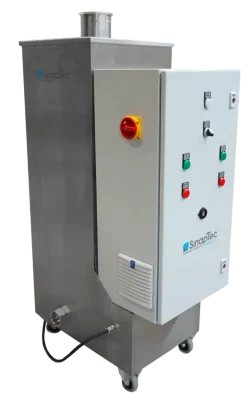
Its unique design in 304L stainless steel (other grades available upon request) is fully compatible with thermal cleaning, mechanical cleaning or chemical cleaning (CIP processes). Cavitation also has a strong bactericidal and virucidal effect, helping to reduce cleaning times, decrease the use of chemical cleaning agents.
Unlike many ultrasonic systems that use bonded probes, the probes used in this pipeline are mechanically mounted, allowing them to be replaced individually.
This simplifies preventive maintenance and corrective maintenance making operations faster, easier, and less costly.
If your process requires multiple ultrasonic pipelines for recirculation or continuous operation, the ultrasonic system can be integrated without modifying existing installations and adapted to the available space.
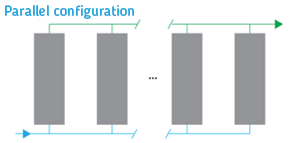

The liquid to be treated can flow at rates of up to 7 m³/h and operate continuously even if it contains particles, as is commonly observed in plant extraction and mixing applications.
It is also suitable for processing liquids under 10 bar pressure and at temperatures of up to 130°C upon request.
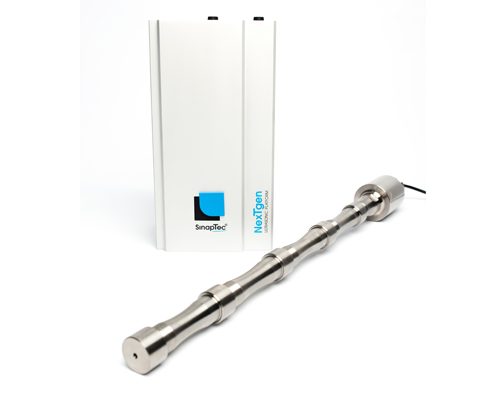
Radial Ultrasonic Probe: A Compact and Durable Model
This equipment is a unique ultrasonic probe on the market.
Its distinctive design allows it to meet the most demanding requirements thanks to a solid titanium construction, which significantly increases its service life and robustness. Indeed, our studies conducted during 24/7 operation over one year show that the equipment remains fully functional and performs just as efficiently as it did at the beginning.
Its fins enable uniform cavitation at 360° along its entire length, ensuring that the entire liquid volume is treated.
This probe is designed to be integrated into an existing tank or pipeline thanks to a standard 1-inch 304L stainless steel fitting.
Available in 20 kHz and 40 kHz versions, it has convinced our industrial customers and R&D partners for several years, from laboratory bench-scale experiments to continuous production applications.
Your Equipment, Our Solutions
All our ultrasonic equipment is 100% manufactured, tested, and validated by our teams at our Lille site. As a manufacturer, we control the entire logistics of our production, and we are also able to meet your specifications by adapting our standard technologies through a co-engineering approach.
In addition, our NexTgen ultrasonic generators, combined with the ultrasonic pipeline and radial probe, provide diagnostic software tools that enable traceability of both the lifecycle of your equipment and the ultrasonic treatment process. This technology allows you to meet your quality and safety standards for finished products.
These software tools also contribute to the training of your staff by providing a real understanding of the ultrasonic phenomenon in operation.
Our engineers are also available to provide remote assistance, regardless of where your equipment is physically located in the world.
For Which Applications?
Indeed, the cavitation produced by the equipment increases the bioavailable fraction of organic matter by breaking up aggregates, thereby improving biogas production yields. In this case, ultrasound is used to pre-treat organic waste before it is sent to anaerobic digestion.
As mentioned previously, cavitation has a significant bactericidal and virucidal effect.
In some cases this phenomenon is not desirable, but in biological applications it can be used for the extraction of proteins, DNA, and RNA.
Plant extraction is also a potential application of ultrasound. Cavitation increases surface porosity, reduces the particle size of the material to be extracted, and also heats the extraction liquid.
This makes it possible to increase extraction kinetics compared with maceration processes, which can be long and energy-intensive. There is no issue with thermosensitive molecules, as the equipment can be programmed to stop automatically when a critical temperature threshold is reached.
The increase in surface porosity can also be applied to the functionalization and production of catalysts, whose exchange surface must be carefully controlled.
Other fields such as emulsification may also benefit, as ultrasound can rapidly produce stable emulsions.
CBD-based emulsions are already among the many applications addressed by our technology.
Ultrasound Alone or Combined?
Our technological expertise continuously leads us to develop new ultrasonic systems to meet very specific requirements.
For several years now, we have been working with French specialists in microwave and supercritical CO₂ technologies in order to combine ultrasound with their technologies.
In some cases, this coupling makes it possible to obtain synergistic effects, as is the case with protein extraction from microalgae when they are subjected to simultaneous ultrasound and microwave treatment.


