
Problem: The Importance of Homogeneity in Liquid Processes
The homogeneity of liquid–liquid and liquid–solid mixtures is undoubtedly one of the most critical factors influencing both process compliance and reaction performance.
Ensuring a homogeneous mixture plays a key role in improving texture and stability in food products, enhancing the safety and bioavailability of active ingredients in pharmaceutical formulations, tailoring and functionalizing material properties…
Leveraging the unique effects of cavitation, ultrasonic homogenization overcomes the limitations of conventional equipment. It enables the production of highly uniform mixtures by controlling both particle size and distribution within a liquid medium, while maintaining optimal efficiency in multiphase systems under moderate operating conditions.
As a result, a homogeneous phase can be achieved as soon as different components are brought into contact.
Have a question about one of the products below?
Feel free to contact us via the menu above or through the link at the bottom of this page.
Principle of Ultrasonic Homogenization: Acoustic Cavitation
Ultrasonic homogenization primarily relies on the phenomenon of acoustic cavitation, which combines mechanical shear effects with micro-scale turbulence within the liquid.
When high-amplitude ultrasonic waves propagate through a liquid, they generate alternating cycles of compression and rarefaction. During these cycles, microscopic cavitation bubbles form, grow progressively under acoustic oscillations, and then collapse violently once they reach a critical size.
The implosion of these bubbles instantaneously creates extreme local conditions at the microscopic scale, with pressures reaching up to approximately 1,000 bar and temperatures approaching 5,000 K.
In a homogenization process, this cavitation effect enables:
-
Reduction of particle size
-
Optimization of particle size distribution
-
Improved dispersion uniformity
-
Promotion of a stable phase formation
Advantages of Ultrasonic Homogenization
Several mechanical technologies can be used to homogenize mixtures, including high-pressure homogenizers, magnetic stirrers, turbine mixers, and microfluidic systems.
However, ultrasonic homogenization offers a range of distinct advantages.
Reduced Processing Time and Energy Efficiency
The implosion of cavitation bubbles generates intense shear forces and micro-jets, capable of rapidly breaking down particles and dispersing phases.
As a result, dispersion and emulsification processes are significantly accelerated, leading to improved process productivity and reduced energy consumption.
High Versatility Across Applications
Ultrasonic technology can be applied to a wide variety of multiphase systems. It enables:
-
Deagglomeration of solid particles, for example to disperse nanopowders in liquids
-
Fragmentation of liquid droplets, such as in oil–water emulsions
-
Disruption of cell walls, for applications like bacterial or plant cell lysis
These mechanisms make it possible to obtain highly uniform and stable dispersed systems.
Low Maintenance and Operational Stability
Ultrasonic systems are based on a simple and robust design, without complex rotating components.
Titanium transducers and sonotrodes provide excellent resistance to corrosion and mechanical fatigue, ensuring reliable continuous operation in demanding industrial environments.
Our Ultrasonic Homogenization Solutions
SinapTec offers a complete range of ultrasonic equipment designed to support the study, optimization, and industrialization of homogenization processes.
Our systems are based on precise digital control of key parameters, including power, frequency, and duty cycle, ensuring consistent energy input and highly reproducible particle size distribution.
These solutions cover the entire process development cycle — from laboratory testing to full-scale industrial implementation.
Ultrasonic Homogenization at Laboratory Scale
Axial Probe Ultrasonic Homogenizers
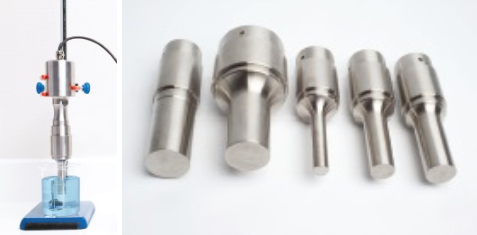
Homogenizers equipped with axial sonotrodes are particularly well suited for the treatment of small volumes requiring high localized ultrasonic intensity.
The selection of the sonotrode allows the adjustment of power and treatment intensity depending on the application, such as dispersion, emulsification, cell lysis, or homogenization.
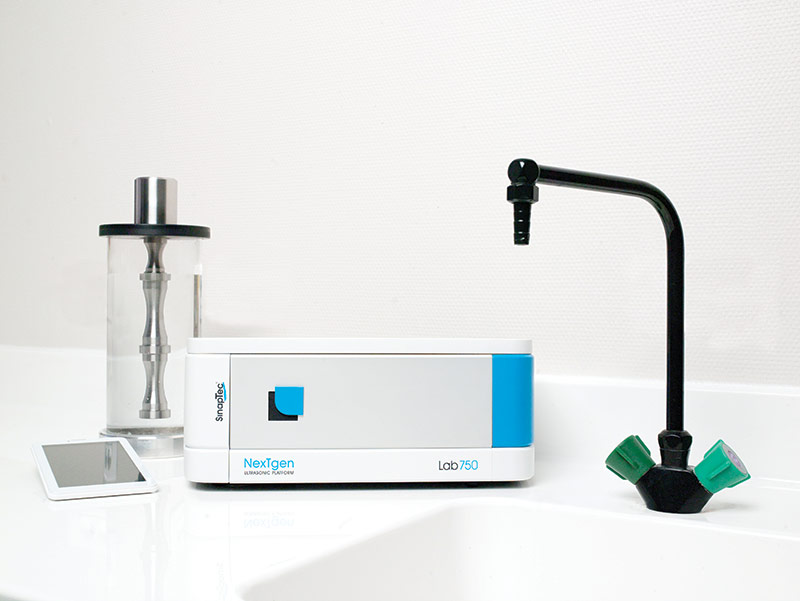
The range includes several models — Lab120, Lab500, and Lab750 — available at different frequencies, including 35 kHz, 20 kHz, and 12 kHz.
Radial Probe Ultrasonic Homogenizers
Systems equipped with radial probes enable the generation of high volumetric power within the liquid, making them well suited for process evaluation in continuous flow configurations.
They are particularly adapted to applications requiring efficient homogenization in larger volumes.
Typical frequency: 20 kHz
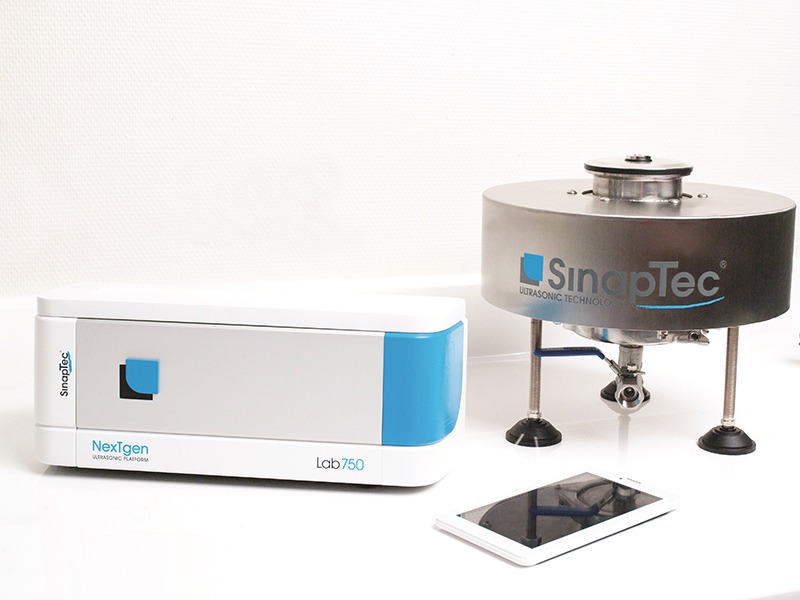
Ultrasonic Reactor (Pipe)
The Pipe system is designed for the study and optimization of processes in continuous flow conditions.
It is a highly relevant tool for preparing industrial scale-up, as it enables the reproduction of processing conditions encountered in production lines.
Typical frequency: 22 kHz
Cup-Horn System
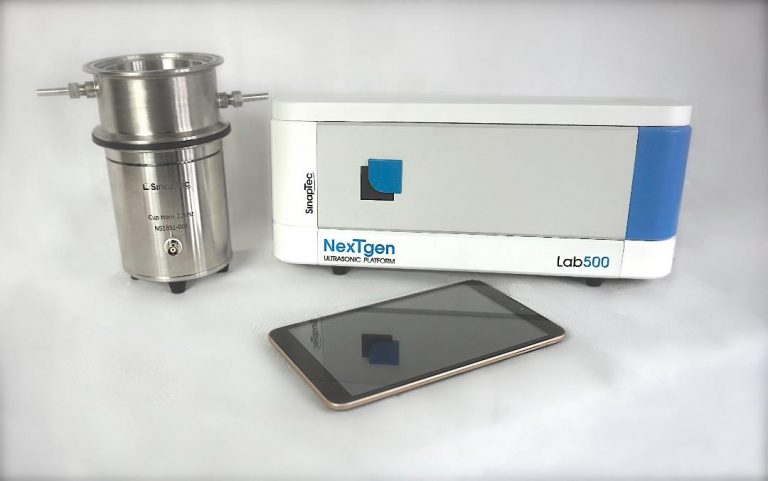
The Cup-Horn range is available over a wide frequency spectrum, from 20 kHz to 500 kHz. Regardless of the selected frequency, key parameters such as power and volume can be kept consistent, making it possible to clearly assess the specific impact of frequency on a given application.
Its flexible design also allows the integration of accessories for applications such as cell lysis or temperature control of samples.
Industrial Scale-Up
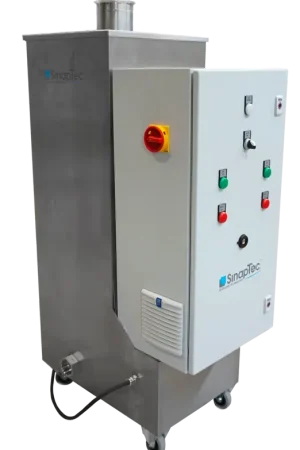
Industrial Ultrasonic Pipe Reactor
Developed in collaboration with industrial partners, the ultrasonic Pipe is a reactor designed for the continuous processing of liquids at industrial scale.
Fully customizable, it can be easily integrated into existing production lines for liquid-phase processes such as homogenization, dispersion, emulsification, and botanical extraction.
Its vibrating tubular reactor design ensures uniform distribution of ultrasonic energy and high processing efficiency.
Learn more about the ultrasonic pipe for industrial applications.
Ultrasonic Bar for Industrial Applications
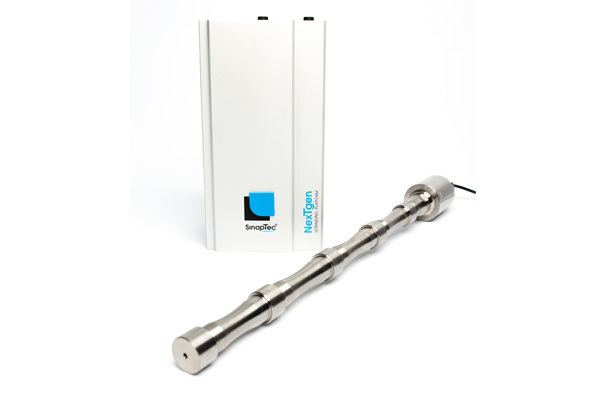
The industrial ultrasonic bar, derived from our laboratory solutions, enables easy integration of ultrasound into existing processes.
Combined with our Inside 1500 generators, it can be installed in a batch tank, a recirculation system, or directly in piping.
Compact and robust, it ensures uniform ultrasonic distribution, high efficiency, and reduced maintenance.
Learn more about the ultrasonic probe.
Applications of Ultrasonic Homogenization
The fundamental value of ultrasonic homogenization lies in its ability to address challenges such as poor dispersion or excessive particle size:
Biopharmaceuticals and Life Sciences:
Used for cell lysis and the release of active compounds. In the development of nano-drug formulations, it helps reduce droplet size, improve solubility, and increase bioavailability.
Food and Beverage Industry:
Applied for emulsification, dispersion, and texture optimization (for example in plant-based protein drinks or dairy products), enhancing mouthfeel and reducing the risk of phase separation.
Materials Science and Nanodispersion:
Enables the deagglomeration of nanopowders (graphene, carbon nanotubes, etc.), improving the homogeneity of conductive inks or composite materials.
Cosmetics and Personal Care:
Reduces the size of oil droplets, improves emulsion stability and texture, and enhances the absorption of active ingredients.
Environmental and Green Processes:
Promotes the degradation of organic pollutants or serves as a sludge pretreatment step to improve dewatering efficiency or biomethane production.
In Summary
Ultrasound-assisted homogenization is a highly effective solution for improving dispersion, emulsification, and particle size reduction across a wide range of industrial processes.
With precise control of ultrasonic parameters and equipment designed for scalability—from laboratory to industrial production—our technology enables efficient optimization of liquid processing while ensuring consistent quality and reproducibility.
Since 1984, SinapTec has been developing and manufacturing ultrasonic solutions for industrial and research applications.
Looking to improve your homogenization process or explore the integration of ultrasound into your system? Contact our team to discuss your project and identify the most suitable solution for your application.


